Overview
Introduction
End-to-end (E2E) solutions for CPE, access and back-office stacks are inherently complex:
- they depend on many different components (CPE, ACS, DHCP, SIP, OSS/BSS, emulators, etc.),
- span multiple layers of integration,
- involve multi-vendor delivery, and
- evolve at varying development cadences with many transitive dependencies.
At every integration level, each incremental change must be validated against multiple, evolving target deployment environments:
- different customers run different topologies and component versions,
- each environment changes over time, and
- late discovery or poor reproducibility of environment differences drives up cost and delays.
The vendor/team challenge
Vendors and engineering teams must simultaneously:
- deliver new functionality,
- design, build, integrate and validate features, and
- avoid regressions — which requires large amounts of regression testing.
To be effective, development and validation must happen against the relevant environments: using the particular versions and configurations of the neighbouring components that exist in a real E2E deployment.
Architecture
Boardfarm’s architecture is designed to address these realities by emphasizing:

- Top-down (inward) dependencies only — stable, inner layers define contracts; outer layers implement them.
- Non-restrictive API standardization — provide clear, compact templates (ABCs) so use cases and tests stay vendor-agnostic.
- Maximized portability — make each layer easy to reuse across customers and testbeds.
- Extensibility via plugins — add new device classes, transports or behaviors as plugins rather than changing the core.
How this is achieved
- Templates (ABCs) define stable device APIs that use cases and hooks rely on.
- Concrete device classes implement those templates for vendors, emulators or transports.
- Pluggy (plugin manager + hooks) orchestrates multi-phase provisioning and lifecycle events across the infrastructure (boot, configure, attach, etc.).
- Use Cases protocol-specific, test-facing operations; the API tests and the interactive shell use.
Together, these principles make Boardfarm a portable, testable framework that helps teams develop, validate and debug E2E functionality against representative, reproducible environments while minimizing the cost of integrating multi-vendor stacks.
Core Components
Templates (ABCs)
What they are: Python Abstract Base Classes that describe the minimal set of methods a device must offer for Boardfarm use cases to work.
Why they matter: Use cases and hooks import these Templates, not concrete device classes. That guarantees portability: a test calls the template API, not vendor-specific code.
Example sketch:
from abc import ABC, abstractmethod

GpvInput = Union[str, list[str]]
GpvStruct = dict[str, Union[str, int, bool]]
GpvResponse = list[GpvStruct]

class ACS(ABC):
    """Boardfarm ACS device template."""

    @abstractmethod
    def GPV(
        self,
        param: GpvInput,
        timeout: int | None = None,
        cpe_id: str | None = None,
    ) -> GpvResponse:
        ...

    ... # rest of the API definition
Guidelines:
- Keep signatures high-level and stable.
- Add capabilities via optional mixins or new ABCs rather than changing existing method signatures.
- Document expected return types and exceptions.
Devices (Concrete implementations)
What they are: Classes that implement a Template (ABC). They translate Template methods into transport-specific actions (SSH, serial, HTTP, local command, docker exec, QEMU socket, etc.).
Important: Device classes may also implement device hooks (
hookspecs) to participate in the boot/provision lifecycle — but those hook implementations should only call the templated APIs and perform device-specific I/O. Avoid exposing these vendor-specific private APIs to use cases.
Example:
from boardfarm3.templates.acs import ACS, GpvInput, GpvResponse

class GenieACS(ACS):

    def GPV(
        self,
        param: GpvInput,
        timeout: int | None = None,
        cpe_id: str | None = None,
    ) -> GpvResponse:
        """Send GetParamaterValues command via ACS server."""
        quoted_id = quote('{"_id":"' + cpe_id + '"}', safe="")
        self._request_post(
            endpoint="/devices/" + quote(cpe_id) + "/tasks",
            data=self._build_input_structs_gpv(param),
            conn_request=True,
            timeout=timeout,
        )
        response_data = self._request_get(
            "/devices"  # noqa: ISC003
            + "?query="
            + quoted_id
            + "&projection="
            + self._build_input_structs(param),
            timeout=timeout,
        )
        return GpvResponse(self._convert_response(response_data))

    ... # rest of the implementation
Rules:
- Devices are only meant to drive I/O and vendor-specific quirks.
- Do not implement business logic in devices — they will always be implemented in use cases.
Use Cases
What they are: The library of testable, protocol-specific operations.
Why use cases?
- Tests call use cases (e.g., GPV, flash_firmware) rather than device methods directly.
- Use cases hide which concrete device handles the operation — the Template contract ensures compatibility.
Example:
"""TR-069 Use cases."""

from __future__ import annotations

if TYPE_CHECKING:
    from boardfarm3.templates.acs import ACS
    from boardfarm3.templates.cpe import CPE

def get_parameter_values(
    params: str | list[str],
    acs: ACS,
    board: CPE,
) -> list[dict[str, Any]]:
    """Perform TR-069 RPC call GetParameterValues."""

    return acs.GPV(params, cpe_id=board.sw.tr69_cpe_id)
Example usage (in IPython or pytest):
from boardfarm3.use_cases.tr069 import get_parameter_values
from boardfarm3.templates.acs import ACS
from boardfarm3.templates.cpe import CPE

from boardfarm3.lib.device_manager import DeviceManager

value = get_parameter_value(
    'Device.DeviceInfo.Manufacturer',
    device_manager.get_device_by_type(ACS),
    device_manager.get_device_by_type(CPE),
    )
Summary
- Stable contract (Template/ABC) — The ACS template (an ABC) declares the
GPV(...) ->GpvResponseAPI and the expected input/output types. - Dependency inversion — Use cases (
get_parameter_values) accept an ACS instance (the interface) rather than a concrete class. - Pluggable device implementations — Concrete classes like
GenieACSimplement the ACS ABC and provide transport/vendor-specific logic. - Runtime selection via DeviceManager — Tests call
device_manager.get_device_by_type(ACS)to obtain any registered ACS device. The test code doesn’t change when you swap GenieACS for AxirosACS (or a simulator). - Easy mocking & CI-friendly — You can inject fakes or mocks that implement the ACS interface for fast, deterministic unit tests and CI runs without hardware.
Result: tests written against the ACS template are vendor-agnostic — you can run the same test suite against real hardware, vendor servers, or simulated ACS backends without changing test code.
Hooks Specification and Pluggy
Boardfarm uses Pluggy as the central plugin manager. Pluggy provides the extension points (@hookspecs) that let different repositories register device classes, extend runner behaviour, and participate in the multi-phase environment boot/provision lifecycle. The design principle is simple:
- Framework (core) concerns are exposed as
core hooks— used to customize runner behavior (CLI args, config parsing, device reservation, environment setup, device registration, release and shutdown). - Device concerns are expressed as
device hooks— implemented by concrete device classes (plugins) to perform boot, configuration, validation and shutdown for that device. - The runner invokes core hooks to orchestrate the run; core hooks in turn cause the runner to call device hooks for each device in the configured order.
Hook categories & where they belong
Core hooks (framework-level) — implemented by runner or plugin authors. These orchestrate the overall lifecycle of a run:
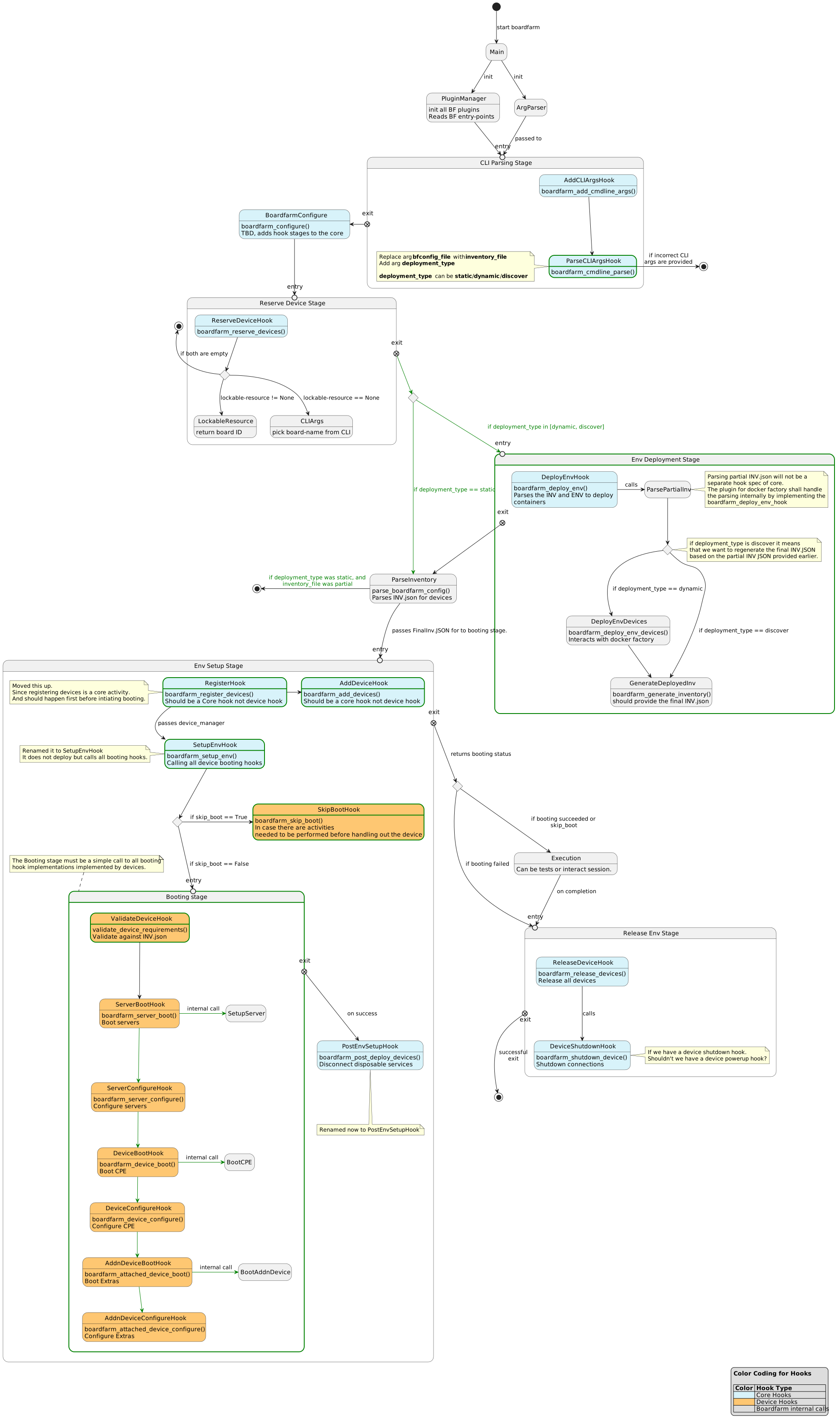
boardfarm_add_cmdline_args(argparser)— add CLI flags.boardfarm_parse_config(...) -> BoardfarmConfig(firstresult) — produce/override the merged run config.boardfarm_reserve_devices(...) -> inventory(firstresult) — reserve lab hardware before deployment.boardfarm_setup_env(...) -> DeviceManager(firstresult) — deploy devices and build theDeviceManager.boardfarm_register_devices(...) -> DeviceManager(firstresult) &boardfarm_add_devices()— register device classes (map inventory"type"→ class).boardfarm_release_devices(...)&boardfarm_shutdown_device()— release reserved devices and perform framework cleanup.
Device hooks (device-level) — implemented by device authors (usually as @hookimpl instance methods on concrete device classes).
These drive device-specific behavior within the lifecycle:
boardfarm_skip_boot— initialize/attach to device without provisioning.boardfarm_server_boot/boardfarm_device_boot/boardfarm_attached_device_boot— boot device categories in sequence.boardfarm_server_configure/boardfarm_device_configure/boardfarm_attached_device_configure— apply environment-driven configuration.contingency_check(env_req, device_manager)— per-test health check used by pytest integration.*_asyncvariants — available where concurrency helps speed up provisioning.
Device categories
A Boardfarm device should be one of:
- server — infrastructure services (ACS, DHCP, SIP, etc.).
- device — main DUTs/CPEs that depend on infrastructure.
- attached device — clients attached to devices (LAN clients, phones, etc.).
Each category participates in different lifecycle phases and must implement hooks appropriate to that category.
Execution order
When boot is enabled, Boardfarm executes device hooks in this order (each name is an actual @hookspec):
boardfarm_server_boot
↓
boardfarm_server_configure
↓
boardfarm_device_boot
↓
boardfarm_device_configure
↓
boardfarm_attached_device_boot
↓
boardfarm_attached_device_configure
Minimal checklist for architecture readers
- Core hooks extend and orchestrate the runner; device hooks implement per-device behavior.
- Use cases depend on Templates (ABCs) only — device implementations plug in behind the Templates via hooks.
- The runner uses core hooks to build the environment and then calls device hooks in the documented order.
- See the dedicated “How to implement” page for step-by-step examples (device skeletons, core hook examples, tests and best practices).
Execution Order (Comprehensive View)
The following diagram explains in brief the execution lifecycle of the boardfarm runner: